



From stainless steel to copper, metals offer a versatile combination of strength, precision, durability, and performance in manufacturing. They can be lightweight or high-strength, conductive or corrosion-resistant, easy to machine or optimal for demanding environments. This guide outlines the most common metals used in manufacturing, compares their properties, and helps you to choose the right one for your application.
Overview of metal materials
Manufacturing metals generally fall into two broad groups: ferrous metals, which are iron-based, such as steel and stainless steel, and non-ferrous metals, such as aluminum, brass, copper, and titanium. Across those families, metals are chosen for a wide range of properties, including mechanical strength, corrosion resistance, conductivity, temperature resistance, and dimensional stability.
The manufacturing process also shapes material choice. CNC machining often favors easy-to-cut metals like aluminum and brass, sheet metal fabrication depends more on formable grades such as aluminum 5052, 5754, and stainless steel 304, while metal 3D printing is limited to specific printable alloys.

Common metals used in manufacturing
Although manufacturers work with many alloys, a small group still dominates modern production: aluminum, stainless steel, mild steel, brass, copper, and titanium. These are the metals engineers most often compare because they cover the needs that show up across many of today’s products, from lightweight EV components to consumer electronics.
Aluminum alloys
Aluminum is a non-ferrous metal, and its alloys are made by adding elements such as magnesium, silicon, or zinc to improve strength, machinability, or corrosion resistance. That mix of low weight, good machinability, and natural corrosion resistance is why aluminum is so frequently used in manufacturing. Aluminum 6061-T6 is the most common general-purpose grade, while aluminum 7075-T6 is a stronger option when load-bearing performance takes priority.
Stainless steel
Stainless steel is an iron-based alloy known for corrosion resistance, durability, and strength. Stainless steel 304/304L is the general-purpose standard, while stainless steel 316/316L offers stronger resistance to salt and chemicals. Some stainless steel grades are also used in elevated-temperature applications, though these are heavier and slower to machine than aluminum.
Carbon and mild steel
Carbon and mild steels are iron-carbon alloys valued for strength, stiffness, weldability, and low cost. Mild steel (typically under 0.3% carbon) is easy to weld and form, higher-carbon grades gain hardness and strength but become less weldable and more brittle. Whichever grade you choose, plain steels need coating or finishing if corrosion is a concern.
Brass and copper
Brass and copper are both non-ferrous, copper-based metals, but they solve different problems. Brass is an alloy of copper and zinc known for its machinability and low friction, while copper stands out for its thermal and electrical conductivity.
Titanium and high-performance metals
Titanium is a non-ferrous metal known for its high strength-to-weight ratio, corrosion resistance, and biocompatibility. Titanium Grade 5 is the most widely used engineering grade, though it is also one of the hardest and most expensive metals to machine. Other high-performance metals fill more specialized roles, such as Inconel 718 for high-heat strength and Invar 36 for extremely low thermal expansion.
Metal comparison table
| Metal | UTS (MPa) | Density (g/cm³) | Corrosion Resistance | Machinability | Relative Cost | Typical Use |
|---|---|---|---|---|---|---|
| Aluminum 6061 | 260–310 | ~2.7 | High | Excellent | €€ | General-purpose brackets, housings, enclosures |
| Aluminum 7075 | 520–560 | ~2.8 | Moderate | Good | €€ | Higher-load lightweight structural parts |
| Stainless Steel 304 | 520–600 | ~8.0 | Very high | Moderate | €€€ | General corrosion-resistant parts and hardware |
| Stainless Steel 316 | 480–600 | ~8.0 | Very high | Moderate | €€€ | Marine, medical, and washdown environments |
| Mild Steel 1018 | 380–450 | ~7.9 | Low | Good | € | Frames, fixtures, supports, machine parts |
| Brass C360 / Cz121 | 330–370 | ~8.5 | Moderate | Excellent | €€€ | Fittings, valves, bushings, connectors |
| Alloy Steel 4140 | 355–370 | ~7.8 | Moderate to poor | Moderate | €€ | Shafts, gears, tooling, higher-stress components |
| Tool Steel H13 | 690 | ~7.8 | Mild | Moderate | €€€ | Dies, hot-work tooling, high-wear components |
| Copper C110 | 220–280 | ~8.9 | Moderate | Good | €€€ | Busbars, heat sinks, electrical parts |
| Titanium Grade 5 | 920–1,000 | ~4.4 | Very high | Difficult | €€€€ | Aerospace, medical, high-performance parts |
| Inconel 718 | 900–930 | ~8.2 | Very high | Difficult | €€€€ | High-strength, heat-resistant aerospace parts |
| Invar 36 | 450–480 | ~8.1 | Poor to medium | Moderate | €€€€ | Precision parts with low thermal expansion |
Final performance depends on grade, temper, geometry, process, and service environment.
How to choose the right metal for your part
Choosing the right metal starts with the demands of the part, which usually includes load, weight, environment, lead time, and budget.
Strength vs. weight requirements
This trade-off is often the first filter. Lighter metals help to reduce part weight and inertia, while heavier metals can offer more stiffness or strength at a lower cost. If weight is not a major constraint and budget is, mild steel is often the most economical starting point for structural parts, but it is much heavier than aluminum or titanium.
-
For lightweight parts: Aluminum is usually the best place to start.
-
For maximum performance at low weight: Titanium is worth considering.
Corrosion resistance
Moisture, chemicals, outdoor exposure, and washdown conditions can rule out some metals quickly. Corrosion-resistant materials can improve part life and reduce the need for protective finishing.
-
For wet or outdoor environments: Stainless steel is the default choice.
-
For lighter parts with added protection: Aluminum with anodizing can work well.
Machinability and lead time
Some metals are easier and faster to machine than others, which affects cycle time, tooling wear, and total cost. In general, materials that cut more easily can help shorten lead times, while harder or more demanding metals often increase both production time and price.
-
For faster machining: Aluminum and brass are usually the easiest options.
-
For harder-to-machine but higher-performance parts: Stainless steel and titanium usually need more time and tooling.
Cost considerations
Raw material cost is only one part of the budget. Machining time, tooling wear, and finishing add processing cost, while limited availability or longer lead times can push prices up further. A low-cost raw material can still lead to a more expensive part if it is slow to machine, hard on tooling, or requires extra finishing.
-
For low-cost structural parts: Mild steel is hard to beat on raw material cost.
-
For strong value across weight, machinability, and cost: Aluminum is a good all-rounder.

Typical applications of metal parts
The fastest way to understand a metal is to look at where it’s most used. Here’s how the most common choices play out across industries.
Aerospace and automotive
In transportation, every gram and every potential failure point comes under the microscope. Aluminum is a popular choice for housings, brackets, and structural parts where reducing mass is a priority, while titanium and specialty alloys step in when higher performance, heat resistance, or corrosion resistance justify the cost.
Industrial equipment
Industrial machinery, tooling, and heavy-duty equipment require metals that can withstand demanding conditions without driving up costs. Mild steel and stainless steel are common in frames, fixtures, guards, housings, and machine components, while stainless steel is especially useful where rust or chemical exposure is a risk, from food-processing lines to chemical tanks. Brass often appears in fittings and valves, while copper is chosen when conductivity is required.
Medical and high-precision components
Medical and precision parts leave very little room for compromise. This is why 316L stainless steel and titanium are top picks for medical devices and precision equipment, where biocompatibility, cleanability, and repeatable accuracy are all critical.
Get a quote for metal parts
Upload your CAD file for an instant quote with free DFM feedback on metal part manufacturability. You can alsobrowse all available materials to compare options before uploading.
Frequently asked questions
What is the best metal for manufacturing?
There is no single best metal. For many parts, aluminum is the best place to start because it balances weight, machinability, and cost.
What is the most machinable metal?
Brass is one of the easiest metals to machine, with aluminum close behind.
Is stainless steel better than mild steel?
Stainless steel is better for corrosion resistance, but not always for cost or machinability.
What metal is best for lightweight parts?
Which metal is best for corrosion resistance?
Stainless steel and titanium are the strongest choices in harsh environments. Aluminum also performs well, especially with anodizing.
How can I reduce the cost of metal parts?
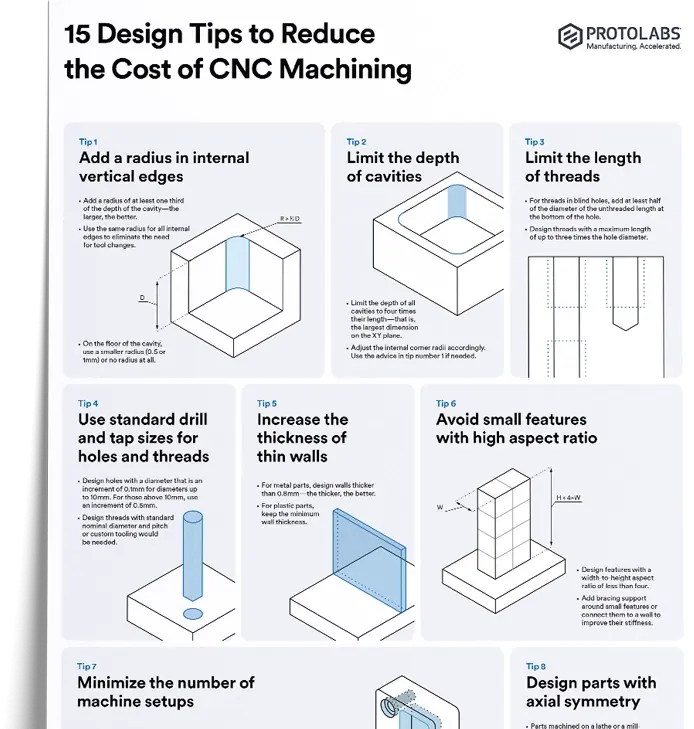
Start with a material that is easy to machine and not over-specified for the job. Simplify the geometry and avoid tight tolerances unless they are truly necessary.