


By removing only a small amount of material, this process ensures the hole is perfectly round and accurately sized for high-precision assemblies.
What is reaming in manufacturing?
Standard drilling typically creates the initial hole but often leaves a rough surface and inconsistent diameter. By contrast, reaming is a dedicated finishing process designed to achieve tight tolerances, often within 0.01 millimeters.
The multi-edged design of a reamer removes a minimal layer of material, which eliminates the spiral marks left by drill bits. This transition from a drilled internal wall to a smooth, reamed surface results in a superior finish. Such precision is essential for high-performance mechanical assemblies, where components such as pins or shafts must fit perfectly.
Reaming versus drilling and boring
Drilling, boring and reaming typically follow a specific sequence to create, enlarge, and refine a hole. Drilling serves as the primary operation to create an initial opening in a solid workpiece. While this method is fast, it often lacks the precision required for perfect fits or smooth internal surfaces.
Once a hole exists, boring is used to enlarge the diameter or correct its axial alignment. This process utilizes a single-point tool to ensure the hole remains perfectly straight and centered.
Reaming acts as the final step to refine the hole size and internal wall smoothness. It removes a minimal layer of metal to achieve exact diameter tolerances and a mirror-like finish. This multi-step approach ensures every hole meets the strict mechanical requirements of complex industrial assemblies.
Common applications of reaming
In the aerospace sector, reaming is important for creating high-quality fastener holes in airframes and engine housings. These holes must withstand immense structural stress and fatigue without failing. Precise dimensions ensure that bolts fit perfectly, which prevents microscopic movements that could lead to cracks.
Automotive manufacturers rely on this process for engine components like cylinder bores and valve guides. Reaming provides the smooth internal finish necessary to reduce friction and wear during high-speed operation. This precision directly improves fuel efficiency and extends the overall lifespan of the engine.
The medical industry also uses reaming, for example for orthopedic implants and specialized surgical tools. Bone reamers create accurate cavities for joint replacements, ensuring a stable fit between the bone and the implant. Surgical instruments also require mirror-like finishes, to prevent bacterial growth and make sterilization easier.
Advantages and disadvantages of reaming
Reaming serves as a high-precision finishing operation, that follows drilling or boring to achieve exact diameter tolerances and superior internal smoothness. This process is highly cost-effective for high-volume production, as it quickly delivers mirror-like finishes across hundreds of identical parts.
Beyond the specialized aerospace and automotive sectors, reaming is vital for the general manufacturing and energy industries.
Hydraulic manifold blocks and pneumatic valves rely on reamed holes to prevent internal leaks and ensure a smooth piston movement. The energy sector utilizes this precision for turbine components and high-pressure fuel systems where tight seals are non-negotiable.
However, reaming cannot correct the position of a hole if the initial drilling was off-center to begin with. Maintaining consistent quality therefore also necessitates the careful management of tool wear, as heat and hard materials degrade the multi-edged cutting surface.
Different types of reaming tools
Hand reamers, chucking reamers, and specialized diemaker’s reamers each play an important role in precision machining. Hand reamers feature a square shank and a long lead-in taper for accurate manual alignment during repair work, while chucking reamers, also known as machine reamers, are designed for high-speed use in CNC machines or lathes. These tools utilize a straight shank that fits securely into a standard collet or chuck.
For mold making, diemaker’s reamers provide a specific geometry with a high-helix angle and a slight taper. This design is essential for creating draft angles and rapidly removing material in complex mold cavities.
How to perform a reaming operation
Achieving a high-precision finish with reaming requires a systematic approach to machine setup and tool handling. The process begins with absolute workpiece security to prevent any vibration during the cutting cycle. You must clamp the part firmly in a vice to maintain precise alignment with the spindle. Any slight shift in the workpiece will lead to an oversized or bell-mouthed hole.
Once the part is secure, proceed by pre-drilling the initial hole. For most materials, the drill size should be 2% to 4% smaller than the final diameter. This specific margin ensures the reamer has enough material to cut without becoming overloaded. Removing too much material causes excessive heat, while removing too little can lead to burnishing.
Lubrication plays a critical role in maintaining surface quality and extending tool life. Apply a high-quality cutting oil throughout the entire operation to reduce friction and clear metal chips. Finally, ensure a consistent pressure application during the feed to prevent the tool from dwelling. A steady movement prevents chatter marks and ensures the final dimensions meet strict mechanical requirements.
Tips for achieving a high-quality finish
To avoid over-reaming, maintain proper feed rates and use appropriate cutting fluids. A slow feed rate can cause the tool to rub, leading to work hardening. Conversely, excessive speed generates heat that can result in an undersized hole once the part cools. High-quality lubricants are important to reduce this friction and flush away metal chips.
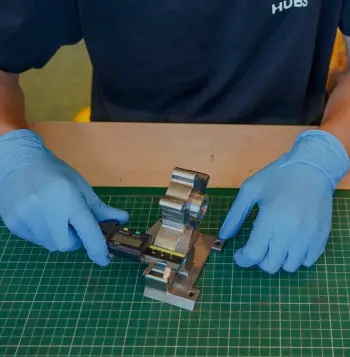
Regular sizing checks with precision plug gauges are also critical to monitor tool wear. Verify that every hole remains within the specified tolerance limits throughout the production run. This prevents costly rework and scrapped components. By following these maintenance steps, you achieve the highest level of accuracy for demanding projects.
Achieve superior hole precision for your next project. Upload your CAD file for a rapid quote and a free DFM analysis.