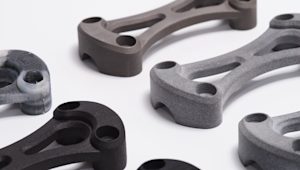
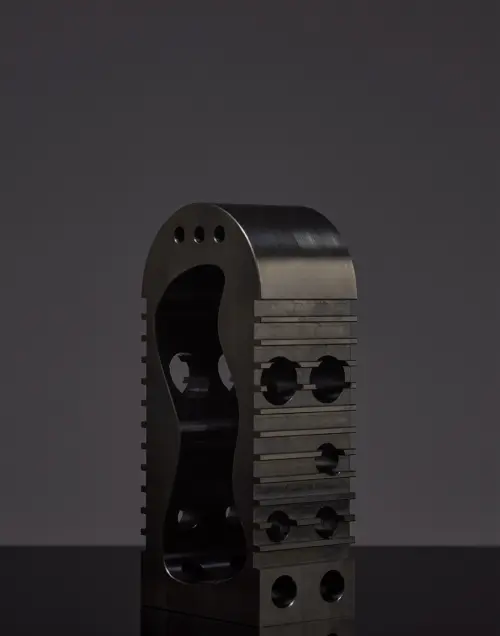

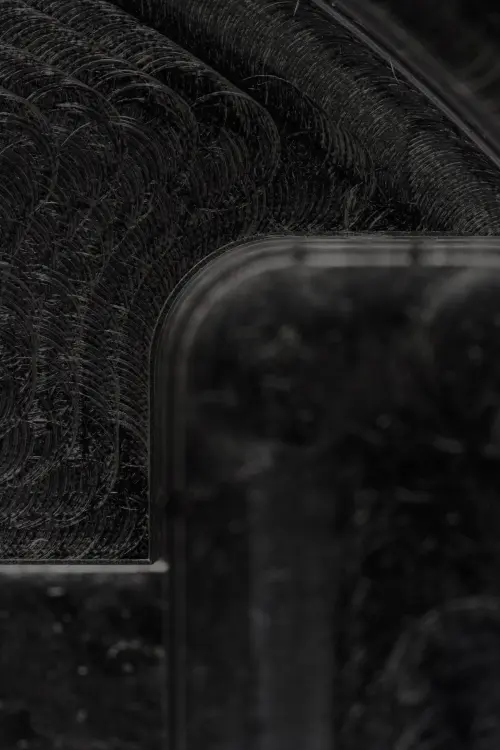
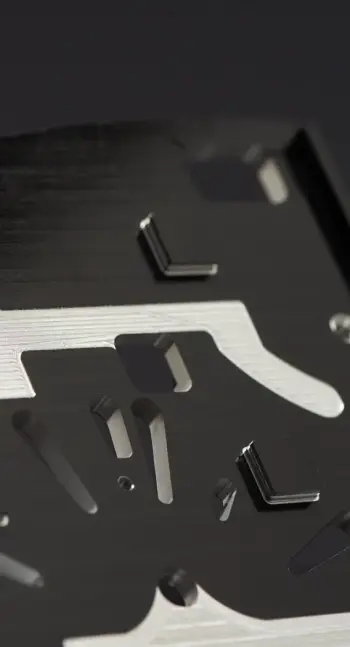

In contrast, SLS fuses thermoplastic powder into durable, support-free components that can withstand mechanical stress. These parts also offer good chemical resistance. Because the surrounding powder supports the build during printing, SLS enables complex geometries that resin-based processes cannot easily achieve.
Ultimately, the right choice depends on whether your application prioritizes fine detail and surface quality or strength and functional durability.
SLA versus SLS at a glance: core differences
Choosing between SLA and SLS is a fundamental trade-off between aesthetic precision and mechanical durability. SLA excels in delivering high-resolution, isotropic parts with a non-porous finish, while SLS is the industry workhorse for rugged and support-free functional components.
| Variable | SLA (Stereolithography) | SLS (Selective Laser Sintering) |
|---|---|---|
| Raw Material | Photopolymer Resin (Liquid) | Thermoplastic Powder (Nylon) |
| Layer Height | 25–100 microns | 100–120 microns |
| Support Structures | Required | Self-Supporting |
While SLA offers superior resolution and thinner layers for intricate details, it relies on sacrificial supports that require manual removal. SLS operates with slightly thicker layers, but leverages its powder bed to eliminate support requirements entirely.
This allows for complex, interlocking geometries and nested builds that are impossible with resin-based systems.
How each technology builds parts layer by layer
SLA relies on vat photopolymerization, where a UV laser traces a cross-section of the part onto the surface of a liquid resin. This exposure triggers a chemical reaction that bonds molecular chains together, selectively curing the liquid into a solid and high-resolution layer.
In contrast, SLS uses a laser to sinter (also known as fusing) particles of nylon powder into solid components. The laser heat raises the material temperature just below its melting point. This bonds the particles together without the need for additional support structures.
Materials: resins, powders, and what they mean
Standard SLA resins are high-resolution but inherently brittle, making them susceptible to cracking under impact or stress. These thermoset polymers offer excellent surface details, but lack the elongation and durability required for mechanical environments.
In contrast, SLS nylon (such as PA12) is a robust thermoplastic engineered for toughness and fatigue resistance. Unlike brittle resins, sintered nylon can withstand significant bending and functional wear. This makes the industry standard for snap-fits, living hinges, and high-performance engineering components.
Mechanical properties and heat resistance compared
A key advantage of SLS is its near-isotropic mechanical behavior, meaning parts maintain their strength consistently. Because the laser fuses the nylon powder into a dense and cohesive structure, the resulting components lack the interlaminar weaknesses often found in other 3D printing methods.
This uniform structural integrity is vital for functional prototyping and end-use applications. Engineers can trust that an SLS part will perform reliably under load, regardless of its orientation during the build process, ensuring predictable results in real-world mechanical testing.
Surface finish, detail, and post‑processing effort
SLA delivers an injection-mold-like quality with nearly invisible layer lines, making it the ideal choice for high-detail visual models and intricate geometries. These parts require minimal finishing to achieve a professional and production-ready appearance directly from the build plate. In contrast, SLS parts feature a slightly grainy, matte texture. To enhance the finish, various post-processing options such as media blasting or dyeing can be applied, effectively smoothing the surface or adding consistent color to functional components.
When to pick SLA versus SLS for your project
Choosing between SLA and SLS depends entirely on your project's final environment. Select SLA for:
-
High-fidelity visual prototypes requiring a retail-ready appearance.
-
Master molds for vacuum casting or rapid tooling.
-
Intricate jewelry and dental models where micron-level detail is critical.
-
Complex geometries that demand the smoothest possible surface finish.
Select SLS for:
-
Functional testing in harsh mechanical or thermal environments.
-
Low-volume production of rugged end-use components.
-
Complex internal channels or nested parts that cannot support manual cleanup.
-
Living hinges and snap-fits that require high fatigue resistance and toughness.
Ready to see your design in hand? Upload your CAD file to the Protolabs Network platform for an instant quote and expert manufacturability analysis. Do you still have questions? Don’t hesitate to contact us.
Frequently asked questions
Is SLA more accurate than SLS?
SLA is generally more accurate and capable of producing finer details than SLS. With layer heights as low as 25 microns and a smaller laser spot size, SLA excels at capturing intricate features and tight tolerances. While SLS is highly consistent for functional parts, its grainier surface and larger layer thickness make it less suitable for applications requiring extreme dimensional precision.
Is resin printing SLS or SLA?
Resin printing is categorized as SLA (Stereolithography) or similar vat photopolymerization technologies like DLP. It uses a liquid photopolymer resin that hardens when exposed to a specific wavelength of light. SLS, conversely, is a powder-bed fusion process that uses dry nylon or polymer powders as opposed to liquid resins.
Is SLA or SLS more expensive?
SLA is typically more cost-effective for small, individual prototypes due to lower material costs and machine overhead. However, SLS becomes more economical for batch production or larger volumes.
Because SLS does not require support structures, parts can be nested tightly within the build chamber, significantly reducing the cost per part when printing multiple items at once.
What are the disadvantages of SLS?
The most significant disadvantages of SLS are its porous surface finish and the potential for thermal warping in large, flat geometries. Unlike the smooth, watertight finish of SLA, SLS parts have a matte, grainy texture that may require additional post-processing such as media blasting or dyeing.
Additionally, the high heat required for sintering can lead to dimensional deviations if the cooling process is not strictly controlled.